Weighing

Interview with Salustiano Ruiz González

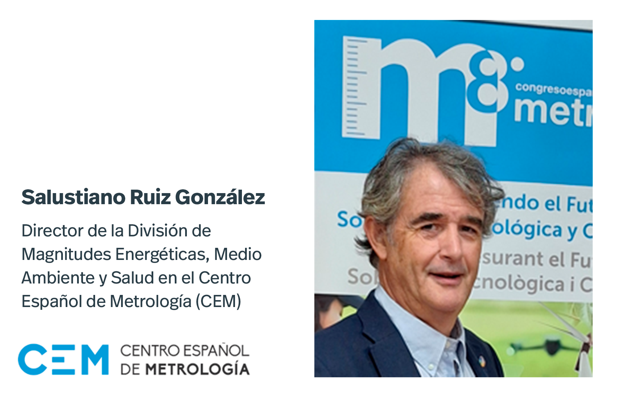
As part of the 8th Spanish Metrology Congress, in which PAYPER will participate this year, we interviewed Salustiano Ruiz González, Director of the Division of Energy Quantities, Environment, and Health at the Spanish Metrology Center (CEM), to discuss the current challenges facing metrology as applied to industry and its role in weighing systems. A conversation about accuracy, reliability, and traceability, but also about digitization, automation, and the importance of integrating metrology from the equipment design stage.

As part of the 8th Spanish Metrology Congress, in which PAYPER will participate this year, we interviewed Salustiano Ruiz González, Director of the Division of Energy Quantities, Environment, and Health at the Spanish Metrology Center (CEM), to discuss the current challenges facing metrology as applied to industry and its role in weighing systems.

A conversation about accuracy, reliability, and traceability, but also about digitization, automation, and the importance of integrating metrology from the equipment design stage.

Salustiano holds a Ph.D. from the University of Valladolid, a degree in Industrial Engineering, a Bachelor’s degree in Electrical Engineering, and a Master’s degree in Research in Thermodynamic Fluid Engineering. He joined the Spanish Metrology Center (CEM) in 1992, where he has built his professional career in the fields of scientific, applied, and legal metrology. He has represented Spain and the CEM in international organizations and forums such as the OIML, WELMEC, and EURAMET. He is currently Director of the CEM’s Division of Energy Quantities, Environment, and Health, where he oversees the areas of Electricity and Energy, Thermodynamics and Environment, and Chemistry and Health, and coordinates activities related to legal metrology and collaboration with the autonomous communities.

1. With the Spanish Metrology Congress just a few days away, what do you consider to be the main challenges currently facing metrology as applied to industry?

<p>Metrology applied to industry is currently facing a shift in scale and nature. It is no longer merely a matter of ensuring traceable measurements in conventional environments, but rather of responding to industrial processes that are increasingly digitized, automated, connected, and subject to stricter regulatory requirements.<br /> Among the main challenges, I would highlight, first, the need to develop metrological capabilities for emerging technologies such as artificial intelligence, advanced sensor technology, the IoT, photonics, quantum computing, and advanced materials. Second, it is necessary to strengthen traceability in dynamic industrial environments, where measurements are often taken online, in real time, and under actual operating conditions. And finally, we must advance the digitization of quality infrastructure, including digital certificates, remote verification, data interoperability, and metrological cybersecurity.<br /> Ultimately, the major challenge is for metrology to support industry in its technological transformation and continue to serve as a guarantee of quality, competitiveness, and trust.</p>

2. In the field of industrial weighing, what role do accuracy, reliability, and traceability play in ensuring quality and confidence in processes?

<p>In industrial weighing, accuracy, reliability, and traceability are essential elements. Weighing plays a role in production processes, commercial transactions, raw material dosing, quality control, logistics, and regulatory compliance. Therefore, a measurement error can have economic, technical, contractual, and even safety implications.<br /> Let’s talk about accuracy rather than precision. Accuracy ensures that the measurement result approximates the true value; reliability guarantees that this result remains stable and reproducible over time; and traceability allows the measurement to be linked to recognized standards, providing comparability and confidence. These three elements are inseparable.<br /> From a metrological perspective, a weighing system legally in service not only fulfills a regulatory obligation but also provides user safety, transparency in operations, and trust among manufacturers, customers, authorities, and consumers.</p>

3. Digitization and automation are transforming industrial processes. What new challenges and opportunities do they present for metrology and weighing systems?

<p>Digitization and automation pose significant challenges for metrology. Weighing systems are no longer merely stand-alone instruments; rather, they are integrated into automated lines, digital platforms, control systems, sensor networks, and smart production environments.<br /> This requires addressing new considerations: the integrity of measurement data, interoperability between devices, cybersecurity, software validation, digital traceability, and the ability to perform remote verifications or checks. It also presents the challenge of measuring accurately under real operating conditions, with faster, continuous, and automated processes.<br /> But these transformations also offer great opportunities. They enable progress toward a more predictive, more efficient, and more integrated approach to metrology within industrial processes. In the case of weighing, digitization can facilitate continuous monitoring of equipment performance, improve maintenance, reduce downtime, optimize processes, and build trust through digital certificates and traceable records.</p>

4. What benefits does the metrological certification of weighing equipment offer the end customer, beyond regulatory compliance?

<p>Conformity assessment, verifications—whether required by regulation or performed on a voluntary basis—and calibrations provide the end customer with something essential: confidence. Obviously, they ensure compliance with applicable legal requirements, but their value goes far beyond mere formal compliance.<br /> Weighing equipment that is legally in service provides assurance regarding the quality of measurements, reduces the risk of error, prevents commercial disputes, improves process control, and contributes to production efficiency. Furthermore, it provides the customer with an objective guarantee that the equipment has been evaluated according to recognized technical criteria and that its results are traceable and comparable.<br /> In industries where weighing directly influences revenue, dosing, product quality, or process safety, this trust holds significant economic and reputational value, as it makes the equipment a reliable component within the customer’s value chain.</p>

5. PAYPER has been metrologically certifying its equipment for over 30 years. From the CEM’s perspective, what value does it add for a manufacturer to maintain this long-term commitment to metrology?

<p>It is highly significant for a manufacturer to maintain a continuous commitment to metrological certification for more than 30 years. This reflects a corporate culture focused on quality, technical reliability, and customer trust.<br /> From the CEM’s perspective, this type of commitment helps strengthen the national metrological ecosystem. Metrology is not solely the responsibility of national institutes, conformity assessors, and authorized verification bodies; it also depends on manufacturers incorporating a culture of measurement into their design, manufacturing, verification, and continuous improvement processes. Obviously, this is not mandatory in the regulatory sphere, but in the voluntary sphere, it depends fundamentally on manufacturers and equipment owners to instill confidence in the system through calibrations performed by laboratories that are signatories to a mutual recognition agreement for calibration results—that is, national metrology institutes and accredited laboratories.<br /> A sustained commitment over time demonstrates technical maturity, adaptation to regulatory changes, and a commitment to maintaining high quality standards. Furthermore, it fosters a stronger relationship among manufacturers, conformity assessors, and metrology institutions, which results in more reliable equipment, more robust processes, and greater market confidence.</p>

6. Certification involves testing, documentation, audits, and adjustments in response to regulatory changes or equipment upgrades. How important is it to incorporate metrological requirements from the design and development phases?

<p>Integrating metrological requirements from the earliest stages of design and development is essential. Metrology should not be viewed as a final step in the process, but rather as a design criterion from the outset.<br /> When metrological requirements are incorporated from the start, technical risks are reduced, costly redesigns are avoided, certification is facilitated, and the robustness of the equipment is improved. Aspects such as measurement stability, protection against tampering, software management, data traceability, operating conditions, and maintainability must be considered from the product’s conception.<br /> This approach is particularly important in the context of digitalization, where equipment increasingly incorporates electronics, software, connectivity, and automated functions. Designing with a metrological perspective allows for anticipating regulatory requirements, improving product reliability, and accelerating time to market.</p>

7. What role does ongoing collaboration between manufacturers, notified bodies, and metrology institutes play in advancing toward increasingly accurate and reliable weighing solutions?

<p>Ongoing collaboration is key. Modern metrology requires a seamless relationship among all stakeholders in the ecosystem: manufacturers, notified bodies, laboratories, national metrology institutes, government agencies, and end-users in industry.<br /> Manufacturers contribute their knowledge of the product, market needs, and actual operating conditions. Notified bodies ensure evaluation in accordance with applicable requirements. And metrology institutes contribute technical expertise, traceability, standards, methods, and a strategic vision for the evolution of measurement.<br /> This collaboration makes it possible to anticipate needs, resolve technical problems, adapt procedures to new technologies, and improve coherence between innovation, regulation, and metrological confidence. In the field of weighing, where equipment is evolving toward more digital, connected, and automated systems, this cooperation is essential to ensure that innovation is accompanied by accuracy, reliability, and legal certainty.<br /> Furthermore, collaboration with manufacturers enables Spanish representatives to defend the interests of Spanish industry in legislative developments at the European level.</p>

8. Finally, what do events like the Spanish Metrology Congress bring to the industry, and what topics would you highlight in particular from this year’s conference?

<p>Events such as the Spanish Metrology Congress—now in its 8th edition—are essential because they connect the metrology community with industry, academia, laboratories, government agencies, conformity assessment bodies, and verifiers—in short, with all stakeholders. They are forums where advancements are shared, needs are identified, regulatory challenges are discussed, and collaborations are forged. Proof of this is the participation of more than four hundred people in this year’s event, along with seven sponsors, four partners, and nine exhibiting companies—among which you are included. We are truly grateful for your participation.<br /> After 32 years, we continue to hold these conferences—and for good reason. For the industry, the conference provides a clear vision of where measurement is headed and how metrology can help improve competitiveness, quality, sustainability, and trust in the markets.<br /> From this year’s event, with the theme “MEASURING THE FUTURE: TECHNOLOGICAL SOVEREIGNTY AND COMPETITIVENESS,” I would particularly highlight topics related to the digitization of metrology, digital certificates, artificial intelligence, advanced sensor technology, the energy transition, sustainability, data traceability, and the modernization of metrological infrastructure. All of these are areas that will shape the future of metrology and its contribution to Spanish industry in the coming years.</p>

Related video

Related images

Precision weighing controller for bagging

Explore Pulsar

Digitalize your production line

Contact us

Let us help you to find the ideal solution for your project.

Contact us

Let us help you to find the ideal solution for your project.

Learn more about our company, the events we participate in, or contact us to join our team.