Pallet protection

Automatic palletizing system: integration with bagging lines

In a bagging line, palletizing is a key stage for maintaining the production pace through to the end of the process.
PAYPER automatic palletizing system integrated with industrial bagging lines
<p>In a bagging line, palletizing is a key stage for maintaining the production pace through to the end of the process. The capacity of the bagging machine, conveyors and the<a href="https://www.payper.com/products/bag-palletizing/"> palletizing system</a> must be correctly sized to prevent accumulation, stoppages and productivity losses.</p> <p>For this reason, choosing an automatic palletizing system is not simply a matter of looking for the highest speed. The type of bag, stacking pattern, required production and pallet stability are some of the factors that determine the most suitable solution.</p>

Conventional and robotic palletizers

<p>PAYPER has two main palletizing technologies: conventional systems and robotic solutions. The choice depends on the characteristics of each installation.</p> <p>Conventional palletizers are particularly suitable for high-production lines and relatively stable formats. PAYPER solutions can reach up to 2,800 bags per hour, making it possible to meet applications where speed is one of the main requirements.</p> <p>This technology uses push and gripper systems. Pushing is suitable for certain bags with regular geometry and high-speed applications, while the gripper allows more specific handling and overlapping, which is particularly relevant for open-mouth bags.</p> <p><a href="https://www.payper.com/payper-palletizing-solutions/">Robotic palletizers</a>, on the other hand, offer greater flexibility for installations working with different formats or patterns. PAYPER has different robotic solutions, such as SCARA systems, gripper robot (R2) and double-gripper robot (R3), which make it possible to adapt handling to the characteristics of the bag and the requirements of each line. These solutions reach up to 1,600 bags per hour and allow different layer configurations to be programmed, facilitating precise and stable palletizing even when different formats or stacking patterns are required.</p>

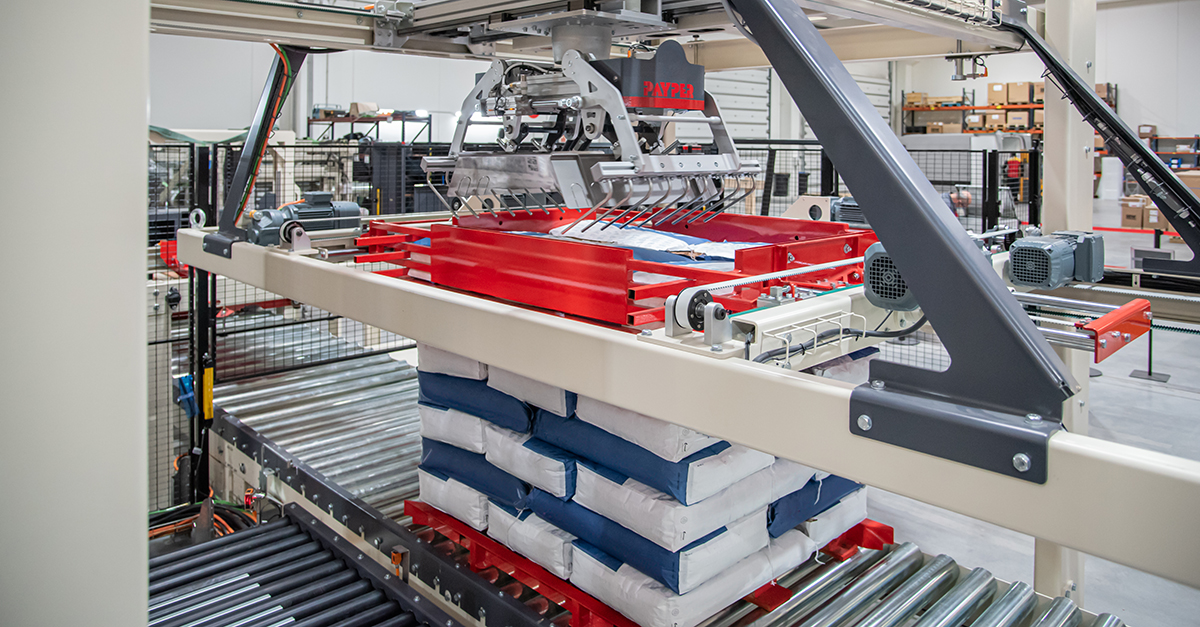
The type of bag determines the handling system

<p>Not all bags behave in the same way during conveying and stacking. An FFS bag with regular geometry can accommodate certain high-speed configurations, while an open-mouth bag may require gripper handling and overlap between bags to improve stability.</p> <p>Therefore, the design of the palletizer must consider both the format and material of the bag and the product it contains. Precision in positioning each unit is essential to achieve uniform layers and a stable load during storage and transport.</p>

Production, layer pattern and end-of-line integration

<p>The nominal capacity of the palletizer must be analyzed together with the production of the bagging machine. If the palletizer cannot absorb the flow of bags, upstream accumulation will occur, eventually affecting the performance of the entire line.</p> <p>It is also necessary to define the palletizing pattern according to the product and the required stability. The distribution of the bags, possible overlap between layers and positioning accuracy directly influence the quality of the final load.</p> <p>In addition, the system can be integrated with other end-of-line equipment, such as bag flatteners, automatic pallet placers and sheet dispensers. In this way, the process can remain automated from bagging through to pallet preparation and protection.</p>

An automatic palletizing system adapted to each line

<p>The right solution is not necessarily the one with the highest capacity, but the one that manages to balance production, flexibility, stability and product characteristics. Proper integration makes it possible to avoid bottlenecks and take advantage of the performance of the entire bagging line.</p> <p>At <a href="https://www.payper.com/about-us/">PAYPER</a> we develop bagging and palletizing solutions adapted to the needs of each installation. If you want to optimize your end-of-line process, <a href="https://www.payper.com/contact-us/">contact PAYPER</a> to analyze the most suitable solution for your process.</p>

Related video

Related images

Explore Pulsar

Digitalize your production line

Contact us

Let us help you to find the ideal solution for your project.

Contact us

Let us help you to find the ideal solution for your project.

Learn more about our company, the events we participate in, or contact us to join our team.