Bagging

Dosing and weighing in bagging: leaders in precision and control

Precision weighing systems have become the true core of any industrial installation aiming to maximise performance, reduce overfilling and guarantee consistent quality.
PAYPER precision weighing systems for industrial bagging and dosing
<p><a href="https://www.payper.com/products/msx-weighing-controller/">Precision weighing systems</a> have become the true core of any industrial installation aiming to maximise performance, reduce overfilling and guarantee consistent quality.</p> <p>As production requirements increase, so do the challenges associated with dynamic weighing. Achieving speeds of more than 2,000 bags per hour while maintaining deviations of just a few grams requires much more than an accurate scale.</p> <p>It is necessary to control variables such as product speed, flow behaviour, system vibrations and the so-called flying product in real time, as these factors directly affect the accuracy of each weighing operation. This knowledge has led PAYPER to develop its own weighing control technologies since the late 1970s, integrating electronics, software and mechanics into a single solution specifically designed for industrial bagging.</p>

Weighing accuracy starts long before the product reaches the bag

<p>Weighing is often associated solely with the moment when the product reaches the weighing hopper. However, from an engineering perspective, accuracy begins much earlier. Every dosing and weighing system starts with a reliable reading obtained through load cells, devices capable of transforming the mechanical deformation caused by weight into an extremely weak electrical signal.</p> <p>To convert this signal into useful information, an electronic chain consisting of filtering, amplification and analogue-to-digital conversion systems comes into play. Only then can the controller interpret the data and make real-time decisions about the dosing process. This processing capability is essential when the objective is not simply to weigh, but to do so while the product continues falling into the weighing container, a situation characteristic of dynamic weighing.</p> <p>The difference between a conventional system and an advanced controller lies precisely in its ability to correctly interpret this information and continuously adapt the behaviour of the line. It is not simply a matter of measuring weight, but of understanding how it evolves during each stage of the cycle and acting before deviations occur.</p>

Dual-flow dosing: the basis of precision weighing systems

<p>Most dosing and weighing systems used in industry operate according to a principle known as dual-flow dosing. This strategy combines an initial fast feeding phase with a second fine dosing stage, making it possible to reach the target weight with high accuracy without significantly reducing productivity.</p> <p>During the first phase, the product enters the hopper at a high flow rate to quickly complete most of the programmed weight. When the controller detects that the target value is approaching, it automatically reduces the flow rate to perform a much more precise adjustment before completely stopping the feed. The concept is simple from a theoretical perspective, but its implementation on high-speed lines involves dealing with physical phenomena that do not occur in manual or low-production processes.</p> <p>At industrial speeds, the product continues moving even after the system orders the feed to close. This situation forces the controller to constantly anticipate the behaviour of the material and accurately calculate the exact moment at which each transition between fast flow, fine flow and final shut-off must occur.</p>

The challenge of flying product

<p>One of the most complex phenomena in dynamic weighing is the so-called flying product. When the controller reduces the flow or stops feeding, a quantity of material is still moving between the dosing system and the weighing container. This product has not yet been registered by the load cells, but it will inevitably become part of the final weight.</p> <p>If the controller waited until the exact target weight was reached before closing the feed, the result would be systematic overfilling. For this reason, control algorithms must accurately calculate how much product remains in flight and anticipate the optimum moment to stop the flow. The accuracy of this calculation is one of the main factors distinguishing a conventional weighing system from an advanced dynamic weighing control system.</p>

Impact and vibrations also affect accuracy

<p>Another aspect that often goes unnoticed is the effect of product impact on the weighing hopper. When the material reaches the container, the kinetic energy generated during the fall causes a temporary reading higher than the actual weight. Added to this are the mechanical vibrations that appear immediately after each impact and make it difficult to obtain a stable measurement.</p> <p>In traditional systems, it is common to wait between one and two seconds for these oscillations to disappear before validating the final weight. Although this strategy improves accuracy, it considerably reduces productivity when operating at high speeds.</p>

Intelligence applied to weighing: how an advanced controller improves productivity

<p>In a high-capacity bagging line, accuracy cannot depend solely on high-quality mechanical components. True performance is achieved when the controller can interpret product behaviour in real time and automatically adapt the dosing process to the conditions of each cycle.</p> <p>This approach is one of the main differences between a conventional electronic controller and an intelligent weighing system such as PAYPER’s MSX. Instead of simply recording the weight reached, the controller continuously analyses the filling progression, calculates the flying product, compensates for detected variations and automatically adjusts the parameters of the next weighing cycle.</p> <p>Thanks to this continuous learning, the system maintains high repeatability even when factors such as product bulk density, feeding rate or environmental conditions change. The result is a much more stable process, with fewer deviations and a significant reduction in overfilling, one of the most important hidden costs in any industrial bagging installation.</p> <p>This self-adjustment capability is particularly relevant in sectors where small weight differences, repeated thousands of times a day, represent considerable economic losses. Instead of manually correcting each deviation, the controller automatically adapts the dosing strategy to maintain accuracy throughout production.</p>

Communication between equipment eliminates unproductive time

<p>In many bagging lines, once bag filling has been completed, the system remains stopped while the resulting weight is checked. Although this procedure guarantees the quality of the final product, it also introduces downtime that reduces actual production capacity.</p> <p>The development of precision weighing systems has made it possible to overcome this limitation through integration between the weighing controller and the checkweigher located at the end of the line. Instead of waiting for validation before starting a new cycle, both pieces of equipment continuously exchange information.</p> <p>While the controller continues filling new bags, the checkweigher analyses the actual weights and automatically transmits detected deviations. The controller incorporates this information into its correction algorithms and adjusts subsequent cycles without having to stop production. This architecture reduces unproductive time and maintains accuracy even on very high-speed lines.</p> <p>According to data presented by PAYPER during its technical webinar, this intelligent communication can increase installation productivity by approximately 5%, simply by eliminating the time previously spent waiting for confirmation of the correct weight before starting the next bagging cycle.</p>

When a few grams make the difference in profitability

<p>In many industrial applications, the economic margin of each bag may seem insignificant when analysed individually. However, when small deviations are multiplied by millions of units produced each year, their impact on profitability takes on a completely different dimension.</p> <p>This phenomenon is particularly evident in industries such as petrochemicals, fertilisers, animal feed or mineral materials, where lines operate continuously for much of the year.</p> <p>During the technical webinar, PAYPER presented the case of a German petrochemical plant equipped with MSX technology. The installation operated at a speed close to 2,200 bags per hour, with a tolerance required by the customer of 10 grams per bag. Thanks to the dynamic control developed by PAYPER, the average deviation was reduced to approximately 3 grams, significantly exceeding the requirements established for production.</p> <p>The consequence of this improvement was not only greater statistical accuracy. The reduction in overfilling made it possible to decrease unnecessary product consumption and generate savings equivalent to approximately 14 additional tonnes marketed each year, without modifying the plant’s production capacity.</p> <p>This example demonstrates that investment in an advanced controller should not be analysed solely from a technological perspective. Its direct impact on product utilisation and overall efficiency makes the weighing system one of the components with the greatest economic return within the entire bagging line.</p>

Digitalisation and connectivity: the next step in dosing and weighing systems

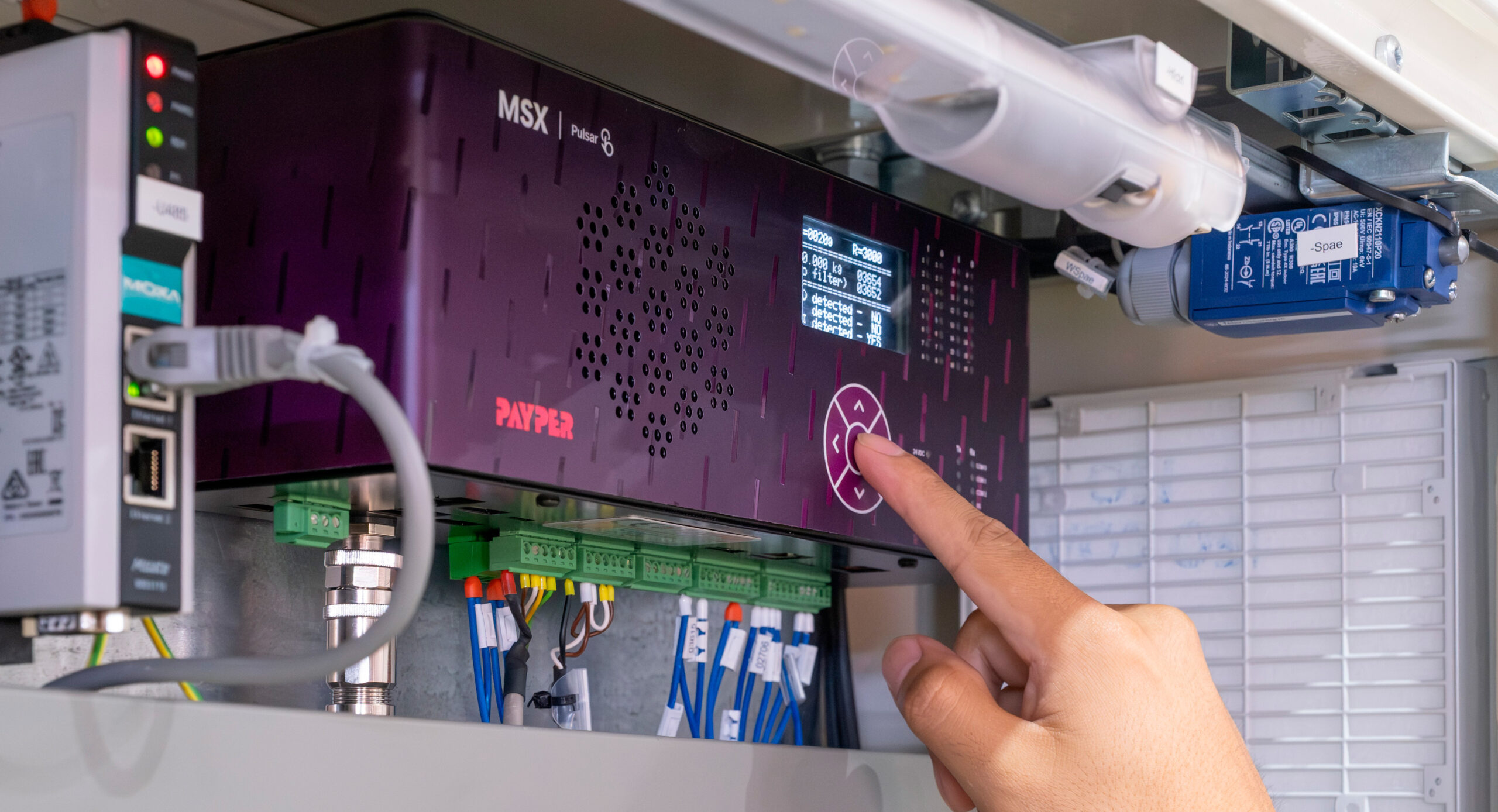
<p>Industrial automation is evolving towards increasingly connected production models. In this scenario, the weighing controller ceases to be an isolated piece of equipment and becomes a continuous source of information capable of feeding monitoring systems, predictive maintenance tools and Industry 4.0 solutions.</p> <p>The MSX controller has been developed according to this philosophy. Its architecture makes it possible to manage production parameters intuitively, store recipes, record operating histories and facilitate remote diagnosis of the installation. This analytical capability not only improves operational control, but also facilitates decision-making based on real production data.</p> <p>For plant managers and maintenance departments, having accurate information about each weighing cycle represents a strategic advantage. It makes it possible to identify trends, anticipate deviations before they affect production and plan maintenance interventions more efficiently, reducing both unexpected downtime and associated costs.</p>

PAYPER: precision engineering applied to industrial bagging

<p>Beyond supplying equipment, PAYPER designs complete solutions in which weighing, dosing, bagging, closing and end-of-line systems work as a single integrated process. This global approach makes it possible to optimise the performance of the entire installation and ensure that each component contributes to the common objective of maximising operational efficiency.</p>

Optimise your processes with precision weighing systems developed by PAYPER

<p>The competitiveness of a bagging line no longer depends solely on producing faster. The true differentiator lies in producing with greater accuracy, minimising product losses and having reliable information that allows the installation’s performance to be continuously improved.</p> <p>The<a href="https://www.payper.com/products/msx-weighing-controller/"> precision weighing systems</a> developed by PAYPER combine decades of engineering experience with proprietary dynamic control technology to provide solutions adapted to the needs of each industry. From medium-capacity lines to installations exceeding two thousand bags per hour, the MSX controller provides the level of accuracy, stability and connectivity required by modern industrial manufacturing.</p> <p>If you want to optimise your dosing and weighing process or develop a new bagging line with the highest level of control, <a href="https://www.payper.com/contact-us/">PAYPER’s</a> technical team can help you design a customised solution that maximises your plant’s productivity and reduces total operating costs.</p>

Related video

Related images

Explore Pulsar

Digitalize your production line

Contact us

Let us help you to find the ideal solution for your project.

Contact us

Let us help you to find the ideal solution for your project.

Learn more about our company, the events we participate in, or contact us to join our team.